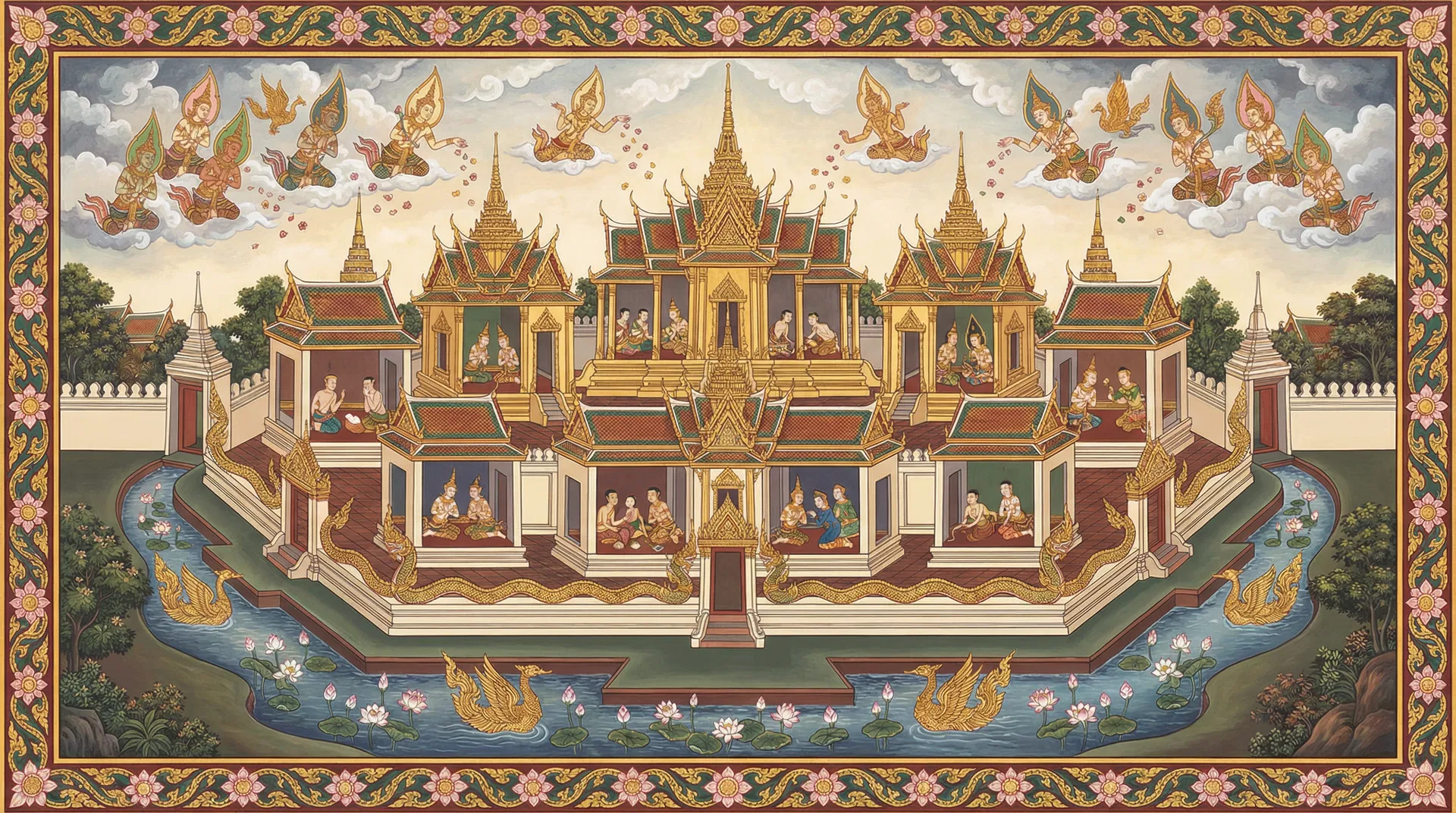
Mahiḷāmuga Jātaka
Mahiḷāmuga Jātaka
In the vibrant city of Varanasi, during an era of great prosperity, there lived a wise and virtuous king named Brahmadatta. His reign was a golden age, characterized by justice, peace, and abundance. The king, however, harbored a secret sorrow. Though blessed with immense wealth and devoted subjects, he yearned for a queen who truly understood his heart and shared his noble aspirations.
One day, the king encountered a young woman of extraordinary beauty and grace named Mahiḷāmuga. She was not a princess by birth, but a woman of exceptional character, known for her sharp intellect and her unwavering honesty. The king was instantly captivated by her wisdom and her pure heart, and he took her as his chief queen.
Queen Mahiḷāmuga proved to be an ideal consort. She possessed a deep understanding of governance and a compassionate nature that perfectly complemented the king's own virtues. Together, they ruled with wisdom, ensuring the welfare of their people. The king showered her with affection and respect, recognizing her as his equal in wisdom and virtue.
However, a group of jealous courtiers, men who clung to outdated traditions and resented a woman's influence in matters of state, began to whisper. They found it unacceptable that the king placed so much trust and affection in a queen who was not of royal blood. They believed that a queen should be subservient and silent, not a partner in governance.
Led by a cunning and ambitious minister named Kāla, these courtiers devised a wicked plan. They spread malicious rumors throughout the city, accusing Queen Mahiḷāmuga of witchcraft and deceit. They claimed that her influence over the king was unnatural, a result of dark magic. Their aim was to turn the people against the queen and force the king to banish her.
The rumors spread like wildfire, poisoning the minds of the citizens. Fear and suspicion began to replace the love and admiration they once held for their queen. King Brahmadatta, though initially dismissive of the baseless accusations, became increasingly troubled by the growing unrest among his people.
One day, Kāla and his conspirators approached the king directly. "Your Majesty," Kāla said, bowing low, "the people are in great distress. They believe the queen practices dark arts and has bewitched you. For the peace of the kingdom, we implore you to banish her."
The king was torn. He loved his queen dearly and knew her innocence, but he also feared the consequences of defying the will of his agitated populace. He decided to put the queen to the test, hoping she could prove her accusers wrong.
He summoned Queen Mahiḷāmuga. "My dearest queen," he said, his voice filled with sadness, "your enemies accuse you of great wrongdoing. To quell the unrest and to prove your innocence, you must perform a deed that demonstrates your purity and your wisdom beyond any doubt. I give you seven days. If you succeed, your honor will be restored. If you fail, you must leave my kingdom forever."
Queen Mahiḷāmuga, though deeply hurt by the king's lack of complete faith, accepted the challenge with dignity. She knew that her accusers were driven by jealousy and that their words were lies. She prayed for guidance and resolved to use her wisdom to overcome this trial.
During the next six days, the queen did not engage in any overt acts. Instead, she spent her time in prayer and quiet contemplation. She visited the poor, the sick, and the downtrodden, offering them comfort and assistance in subtle ways, without fanfare. She also spent time studying ancient scriptures, seeking deeper insights into virtue and truth.
On the seventh day, the king convened a grand assembly. The people gathered, eager to see the queen's fate. Kāla and his followers were confident of their victory.
Queen Mahiḷāmuga appeared before the assembly, not in elaborate attire, but in simple, clean robes. She stood before the king and the multitude, her presence radiating a quiet strength. She did not accuse her enemies nor did she defend herself with angry words.
Instead, she spoke softly, her voice clear and resonant. "Your Majesty, and all my people," she began. "I have been accused of deceit and dark arts. I have been asked to prove my purity. I have done so not through grand displays, but through quiet acts of compassion and truth. For the past six days, I have offered what little I could to those in need. I have listened to the suffering of the poor, comforted the sick, and sought wisdom in the teachings of the enlightened ones."
She then turned to Kāla and the courtiers. "You accuse me of witchcraft. But true power lies not in deception, but in kindness. True influence comes not from manipulation, but from integrity. The greatest magic is the magic of a compassionate heart."
She then presented a small, intricately woven basket filled with medicinal herbs she had gathered and prepared herself. "This basket," she said, "contains remedies for the ailments of the common people, gathered with care and prepared with knowledge passed down through generations. It is a symbol of my dedication to your well-being."
The assembly was silent, awestruck by her humility and wisdom. The people who had been helped by her quiet gestures came forward, testifying to her kindness and genuine compassion. Kāla and his followers were shamed into silence. Their lies were exposed by the queen's virtuous actions.
King Brahmadatta, his heart filled with renewed love and admiration, embraced his queen. "Mahiḷāmuga," he declared, his voice ringing with pride, "you have proven yourself not only innocent but also a paragon of virtue and wisdom. You are the true jewel of my kingdom."
The people cheered, their faith in their queen restored tenfold. Kāla and his conspirators were stripped of their positions and banished from the court. Queen Mahiḷāmuga continued to reign by the king's side, her wisdom and compassion guiding the kingdom to even greater heights of prosperity and peace.
— In-Article Ad —
💡Moral of the Story
True virtue and influence are demonstrated through consistent acts of compassion, integrity, and wisdom, rather than through outward displays or deceitful words. Jealousy and malice are ultimately exposed by the light of truth and virtuous action.
Perfection: Ñāṇa Paramī (Perfection of Wisdom), Khanti Paramī (Perfection of Patience and Forbearance)
— Ad Space (728x90) —
More Jataka Tales You May Enjoy
 36Ekanipāta
The Tale of the Horse-Breeder
In a past aeon, in the flourishing city of Varanasi, the Bodhisatta was born as a young Brahmin, end...
💡 The highest form of virtue is selfless compassion, willing to sacrifice for the well-being of others.
14EkanipātaThe Bodhisatta as a Hunter
The Bodhisatta as a HunterIn the dense, untamed wilderness of the Himalayas, where snow-capped peaks...
💡 True compassion transcends self-preservation, and great sacrifices bring immeasurable blessings.
 276Tikanipāta
Mugapakkha Jataka
The Tale of the Mute Prince In the ancient kingdom of Mithila, a wise king reigned with a heart as v...
💡 True communication transcends words; it is found in understanding, empathy, and compassionate actions. Leadership is demonstrated through deeds, not just pronouncements.
 476Terasanipāta
Mugapakkha Jataka
Mugapakkha Jataka In the ancient land of Mithila, there lived a king named Janaka, a ruler of great ...
💡 True enlightenment and peace come from conquering one's own mind and acting with pure, selfless intentions, free from ego and the desire for recognition.
39EkanipātaThe Tale of the Proud Peacock
In a time long past, in the glorious city of Benares, King Brahmadatta ruled wisely. One day, as the...
💡 Wisdom and discernment, coupled with unwavering truthfulness, can expose deception and safeguard against manipulation.
4EkanipātaThe Tale of the Excellent Archer
The Tale of the Excellent Archer In the ancient kingdom of Mithila, a land blessed with fertile pla...
💡 Accusing others without reason and having impure intentions inevitably lead to one's own suffering. Forgiveness and genuinely good deeds are the path to peace and happiness.
— Multiplex Ad —